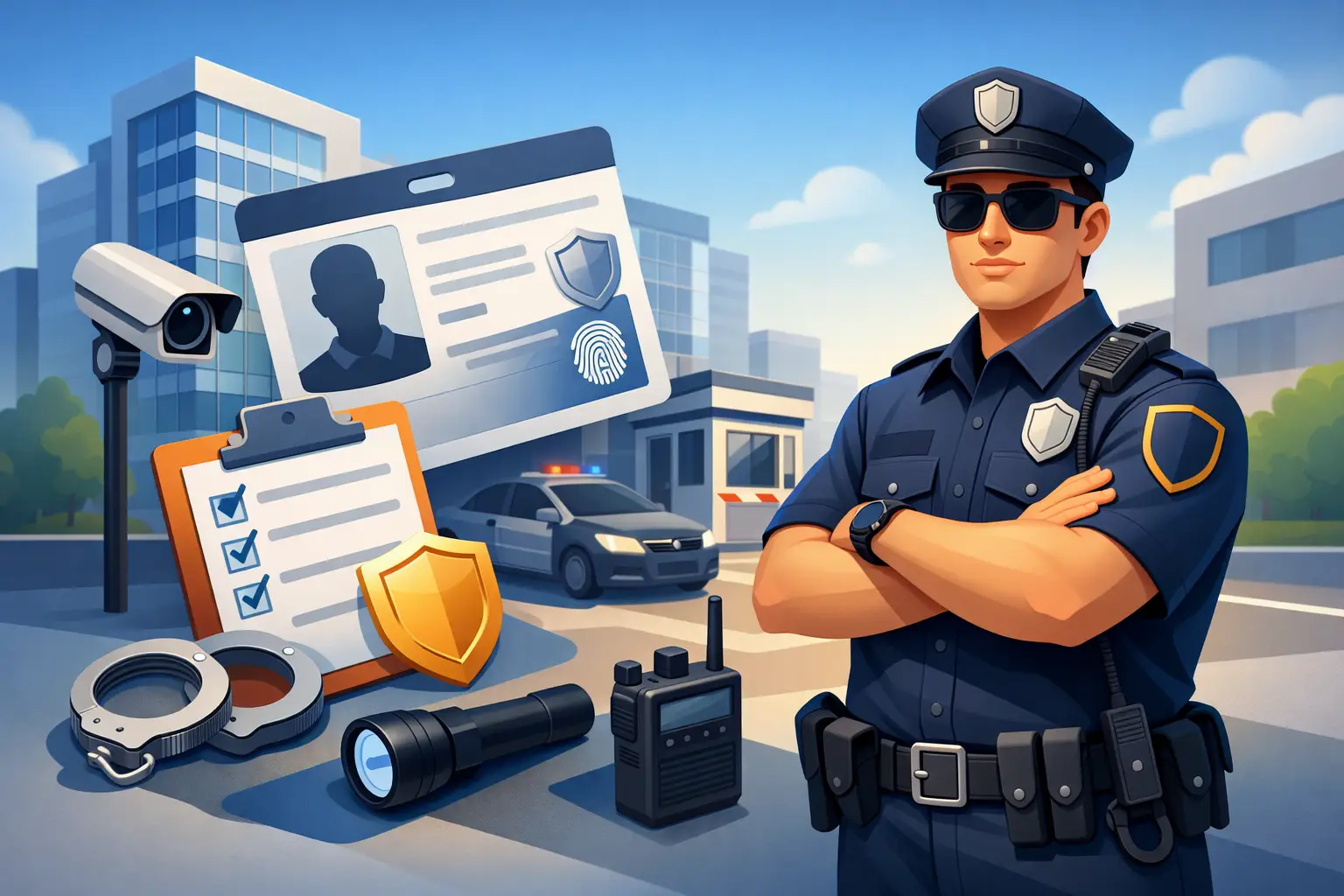
What Is a Licensed Security Guard?
If you are hiring security for a venue, office, event, or worksite, one question matters immediately: what is a licensed security guard, and how is that different from simply having someone in a uniform at the door? The answer affects safety, compliance, liability, and the way your business is perceived by staff, customers, and guests.
A licensed security guard is a security professional who has been authorized by the relevant state authority to perform security duties legally. That license is not just an ID card. It signals that the individual has met required standards for training, background checks, and lawful conduct within the scope of private security work. For businesses, that distinction matters because licensed guarding is about risk control, not appearances.
What is a licensed security guard in practical terms?
In practical terms, a licensed security guard is someone approved to carry out specific protective duties such as access control, incident response, patrols, asset protection, crowd monitoring, and site reporting. The exact license categories and requirements vary by state, but the underlying purpose is consistent: only qualified people should be trusted to protect people, property, and operations.
That means a licensed guard is typically trained in areas such as observation, conflict de-escalation, emergency procedures, communication, lawful powers, and incident documentation. Depending on the assignment, they may also be licensed for crowd control, personal protection, or other specialized functions. A concert, corporate tower, hotel, construction site, and executive protection detail do not carry the same risks, so licensing and role fit both matter.
For a business decision-maker, this is where the issue becomes operational rather than theoretical. You are not simply buying a presence. You are engaging a person who may be first to respond when a guest becomes aggressive, a restricted area is breached, a theft is suspected, or an evacuation begins.
Why licensing matters to businesses
Licensing creates a basic threshold of accountability. It helps confirm that the guard has gone through approved training and has been vetted to work in the security industry. That does not guarantee excellence on its own, but it does separate compliant providers from unqualified labor being used as a substitute for real security.
This matters because the cost of getting security wrong is usually higher than the cost of hiring properly in the first place. An unlicensed or poorly managed guard can escalate conflict, mishandle evidence, miss safety issues, or expose your business to compliance problems. In public-facing environments, they can also damage customer confidence very quickly.
Licensed guarding also supports insurance, reporting, and procurement requirements. Many organizations need vendors that can demonstrate proper licensing, documented procedures, and a professional standard of service. For larger venues and enterprise clients, security is not a casual purchase. It is part of governance, duty of care, and business continuity.
What a licensed security guard actually does
The public image of a security guard is often too narrow. People imagine someone standing still at an entrance, checking who comes in and out. In reality, the role is broader and more active.
A licensed guard may control access to a building, verify credentials, monitor visitor activity, patrol internal and external areas, identify suspicious behavior, assist with emergency response, and document incidents in a way that supports management follow-up. In event or hospitality settings, they may also manage lines, monitor intoxication-related risks, support crowd movement, and intervene early when tensions start rising.
At corporate sites, the emphasis may be on professionalism, discretion, and preventing disruption. At construction or industrial sites, asset protection, perimeter checks, and after-hours patrols may be more important. At clubs, bars, and live events, visibility, crowd control, and fast judgment under pressure become central to the job.
So when clients ask what is a licensed security guard, the most useful answer is this: it is a trained, authorized professional whose role is to reduce risk before it turns into loss, disruption, or harm.
Licensing does not mean every guard is the same
This is where many buyers need a clearer picture. A licensed guard is not automatically the right guard for every site. Licensing is the baseline. Suitability comes from experience, site briefing, supervision, communication standards, and the provider’s ability to match personnel to the environment.
For example, a luxury hotel needs a different service style than a late-night entertainment venue. A corporate reception requires polished communication and low-friction visitor management. A festival entry point may require stronger crowd control capability and more assertive incident handling. Both assignments may require licensed personnel, but the skill mix is different.
That is why serious security providers focus on tailored deployment rather than one-size-fits-all staffing. The best results come when the guard’s licensing, training, and temperament align with the site’s risk profile.
What to look for beyond the license
If you are evaluating providers, the license should be the starting point, not the finish line. A guard can be legally licensed and still poorly supported by the company behind them. Businesses should also look at supervision, communication protocols, insurance, operating procedures, and service consistency.
A dependable provider should be able to explain how incidents are reported, how shifts are covered, how guards are briefed, and how quality is maintained across sites. If your environment is high-footfall, high-visibility, or reputation-sensitive, you should also care about presentation, customer interaction, and escalation judgment.
This is especially relevant for venues, events, hospitality groups, and multi-site operators. Security personnel are often the first and last people a guest sees. They represent order, authority, and trust at the same time. That requires more than a valid license. It requires discipline and professionalism in the field.
Common misconceptions about licensed security guards
One common misconception is that licensed guards have the same powers as police. They do not. Private security operates within a defined legal scope. Their role is to observe, deter, report, manage access, respond within policy, and contact emergency services or law enforcement when needed. Professional guards understand those boundaries and work effectively within them.
Another misconception is that visible security is only needed after incidents start happening. In reality, the value of a licensed security guard is often preventive. A professional presence can discourage theft, reduce disorderly behavior, reinforce site rules, and help staff feel supported before a situation escalates.
There is also a tendency to treat security as a commodity. That approach usually creates problems. When buyers focus only on price, they may end up with inconsistent staffing, weak reporting, poor punctuality, or guards who are technically present but operationally ineffective. Security works best when it is treated as a risk management function, not just a line item.
When businesses typically need licensed guarding
Not every site requires the same level of coverage at all times, but many businesses benefit from licensed guarding when there is public access, valuable assets, reputational exposure, or a realistic chance of conflict or unauthorized entry.
That includes office buildings, front desks, hotels, restaurants, bars, nightclubs, retail-adjacent sites, loading docks, construction projects, events, concerts, and executive movements. Some businesses need permanent static guarding. Others need flexible event-based deployment or support during peak periods, renovations, staff shortages, or elevated risk windows.
The right setup depends on the site. In some cases, a highly visible guard is the priority. In others, the main value is controlled access, accurate incident logs, and calm handling of issues before they become disruptive.
Choosing a provider with confidence
When you engage a security company, you are trusting that provider with more than a post to fill. You are trusting them with people, assets, brand reputation, and operational continuity. That is why the provider’s standards matter as much as the individual guard’s credentials.
A company like Broadsafe Group positions licensed security as part of a broader service commitment built on professionalism, accountability, and tailored site coverage. For buyers, that kind of model is valuable because security rarely succeeds on staffing alone. It succeeds when licensed personnel are backed by clear procedures, responsive management, and a service structure that can adapt to your environment.
If you have been asking what is a licensed security guard, the simplest answer is that it is a qualified professional who is legally approved to protect people and property within a defined role. The more useful answer is that a licensed guard gives your business a trained first line of prevention, response, and reassurance. When the setting is busy, public-facing, or high-risk, that difference is easy to see long before anything goes wrong.
The safest hiring decision is usually the one that looks past the uniform and asks whether the person on site is properly licensed, properly supported, and properly matched to the job.