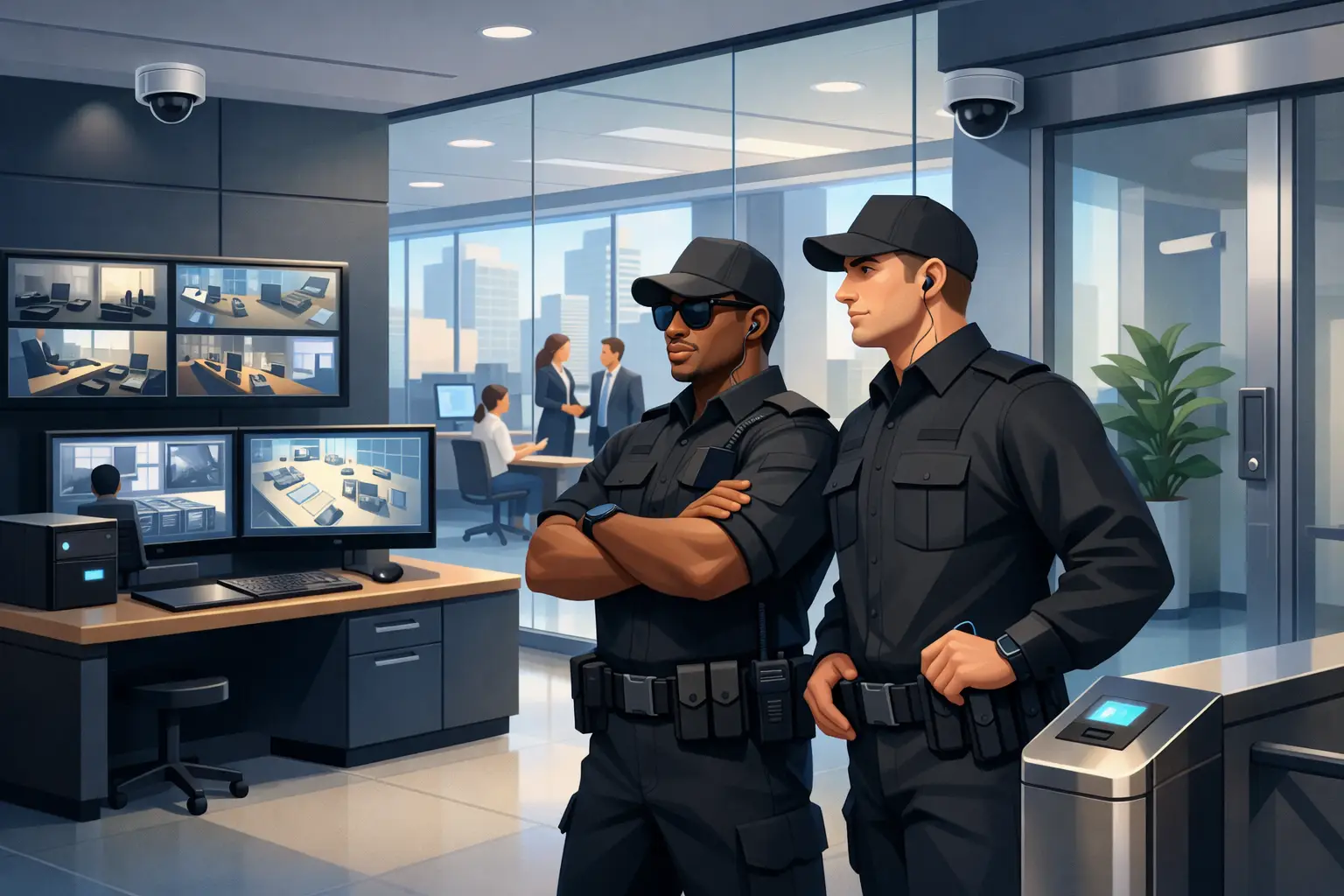
Corporate Office Security Guards That Protect Workplaces
A front desk can be welcoming without being unprotected. The difference is often the presence of corporate office security guards who know the building, understand visitor expectations, and can respond calmly when something does not look right. For facilities teams and operations leaders, that visible, professional coverage protects more than equipment or access points. It supports employee confidence, tenant relationships, business continuity, and the reputation of the organization.
Office security is not a one-size-fits-all assignment. A single-tenant headquarters, a shared commercial tower, a regional office with sensitive records, and a public-facing corporate campus each carry different risks. The right approach starts with the realities of the site, not a generic guard schedule.
What Corporate Office Security Guards Actually Do
A professional office guard is not simply stationed at a doorway. They are a controlled, customer-facing part of the workplace operation. Their responsibilities may include monitoring entry and exit points, managing visitor registration, issuing credentials, conducting patrols, observing cameras, escorting contractors, and documenting incidents.
Just as importantly, guards provide judgment. An access-control system may record a forced door, but it cannot speak with the person nearby, assess whether there is an immediate risk, secure the area, or coordinate an appropriate response. A trained guard adds situational awareness to the technology already in place.
The most effective assignments balance security with hospitality. Employees, clients, delivery drivers, and maintenance contractors should encounter a clear, respectful process. A guard who is overly passive can create gaps. A guard who is unnecessarily confrontational can make a professional workplace feel hostile. The standard should be firm access control delivered with courtesy and consistency.
Why a Visible Security Presence Changes Behavior
Many office security issues begin as small deviations from procedure: a visitor follows an employee through a secured door, a contractor arrives without a confirmed work order, or an unattended package is left in a reception area. These moments need early attention before they become disruptions.
A uniformed, attentive security professional provides a visible deterrent to unauthorized access, theft, vandalism, and aggressive behavior. Their presence also reassures staff who work early shifts, late hours, or in offices with public reception areas. This can be particularly valuable for businesses handling confidential information, high-value assets, executive visitors, cash transactions, or sensitive customer records.
Visibility alone is not enough, however. A guard must be positioned with purpose. Placing someone at a lobby desk may be appropriate for a high-traffic building, while a larger campus may need patrol coverage, loading dock checks, and oversight of multiple entry points. Coverage should follow risk, foot traffic, and operating hours.
Start With a Site-Specific Risk Assessment
Before engaging a provider, define what needs protection and where the weak points are. This does not require treating every office like a high-security facility. It requires being honest about how people enter, move through, and use the site.
Consider the building layout, visitor volume, public access, parking areas, loading zones, after-hours occupancy, and the reliability of existing access systems. Review prior incidents, even those that seemed minor. Repeated tailgating, missing property, unescorted vendors, staff concerns, and unclear emergency procedures often reveal where a stronger security presence is needed.
The assessment should also account for your organization’s culture. A law firm, technology company, hospital administration office, financial services office, and corporate headquarters may all require controlled access, but the tone and procedures will differ. Security should support the workplace experience while maintaining clear boundaries.
Define the Guard’s Authority and Escalation Process
Confusion about authority creates avoidable risk. Staff should know what the guard is responsible for, when management must be notified, and when emergency services should be contacted. The guard should know who can approve visitor access, who handles employee conduct issues, and who receives incident reports.
Clear post orders are essential. They should cover access procedures, visitor verification, patrol routes, key and credential control, emergency contacts, reporting requirements, and site-specific rules. They should also address sensitive situations, such as an upset former employee, a domestic violence concern, a medical incident, or a person refusing to leave the property.
A well-written escalation process avoids two common failures: overreaction to routine matters and delayed action during genuine threats. Guards need the confidence to act within their role and the discipline to escalate appropriately.
Build Coverage Around Real Operating Hours
The busiest time is not always the riskiest time. A lobby may be full during business hours but have strong natural oversight from staff and visitors. Early mornings, evenings, weekends, and periods when contractors are on site can present a different set of vulnerabilities.
For some offices, a daytime lobby guard is the right solution. For others, mobile patrols, after-hours access control, or a combination of on-site and remote monitoring may be more practical. Multi-tenant buildings may require coverage that coordinates with property management, elevators, parking operations, and individual tenant policies.
Cost matters, and not every site needs a guard around the clock. Reducing coverage solely by hours, though, can create a false economy if it leaves the highest-risk periods unprotected. A capable security provider can help identify where scheduled coverage delivers the greatest value and where technology or revised procedures can support the plan.
Choose Professionalism Over a Basic Staffing Model
The quality of the individual assigned to your site is central, but the provider’s operating standards matter just as much. A guard who arrives on time is only the starting point. Corporate environments need personnel who communicate clearly, maintain a professional appearance, write accurate reports, protect confidential information, and remain composed under pressure.
Ask how officers are screened, licensed where required, trained, supervised, and replaced if they are unavailable. Review how the provider handles shift handovers, incident reporting, quality checks, and client communication. A security partner should be able to explain these processes plainly rather than offering vague assurances.
Credentials and insurance should also be verified. Businesses should look for appropriate licensing, meaningful insurance coverage, documented health and safety practices, and quality management processes. Providers aligned with recognized standards, including ISO 9001 and ISO 45001 principles, demonstrate a disciplined approach to service consistency and workplace safety.
Broadsafe Group approaches corporate protection with this operational mindset: licensed personnel, tailored coverage, and accountable service designed around the realities of each site.
Technology Works Best With People Behind It
Access cards, visitor management platforms, cameras, intercoms, alarms, and electronic patrol verification can strengthen office security. They create records, improve visibility, and help teams identify patterns. Yet technology still depends on correct use and timely action.
A visitor management system is valuable only when visitors are properly checked in. Cameras are useful only when someone can recognize suspicious activity and respond according to procedure. Access data can identify an anomaly, but it may take a guard to investigate a propped door or locate a person in a restricted area.
The strongest arrangements connect trained personnel with practical technology. Guards should understand the systems they are expected to operate, while facilities and IT teams should know how incidents are reported and how evidence is preserved. This is especially relevant when physical access, network equipment, server rooms, and confidential information intersect.
Measure Service Through Communication and Reporting
Security performance is often most visible after an incident, but it should be managed well before one occurs. Routine reporting gives facilities leaders a picture of what is happening across the site: visitor trends, access concerns, maintenance hazards, parking issues, recurring policy breaches, and patrol completion.
Reports should be factual, timely, and useful. They should explain what occurred, what action was taken, who was notified, and whether follow-up is required. Overly brief reports leave management without context. Overly dramatic reports can create unnecessary concern. Professional reporting focuses on accurate observations and practical next steps.
Regular service reviews are equally valuable. As your office grows, changes floors, adds employees, hosts more clients, or adjusts operating hours, the security plan should change with it. A provider that checks in only at contract renewal is providing staffing, not partnership.
A Security Plan Should Feel Controlled, Not Restrictive
Employees should not have to think about security at every turn. When coverage is well designed, access is orderly, visitors are handled professionally, concerns are addressed early, and staff know where to turn when something feels wrong.
That is the real value of corporate office security guards. They create a calm, accountable layer of protection that lets people focus on their work while the workplace remains prepared for the unexpected. Start with the risks specific to your site, set clear expectations, and choose people who can represent your organization with the same professionalism you expect from your own team.