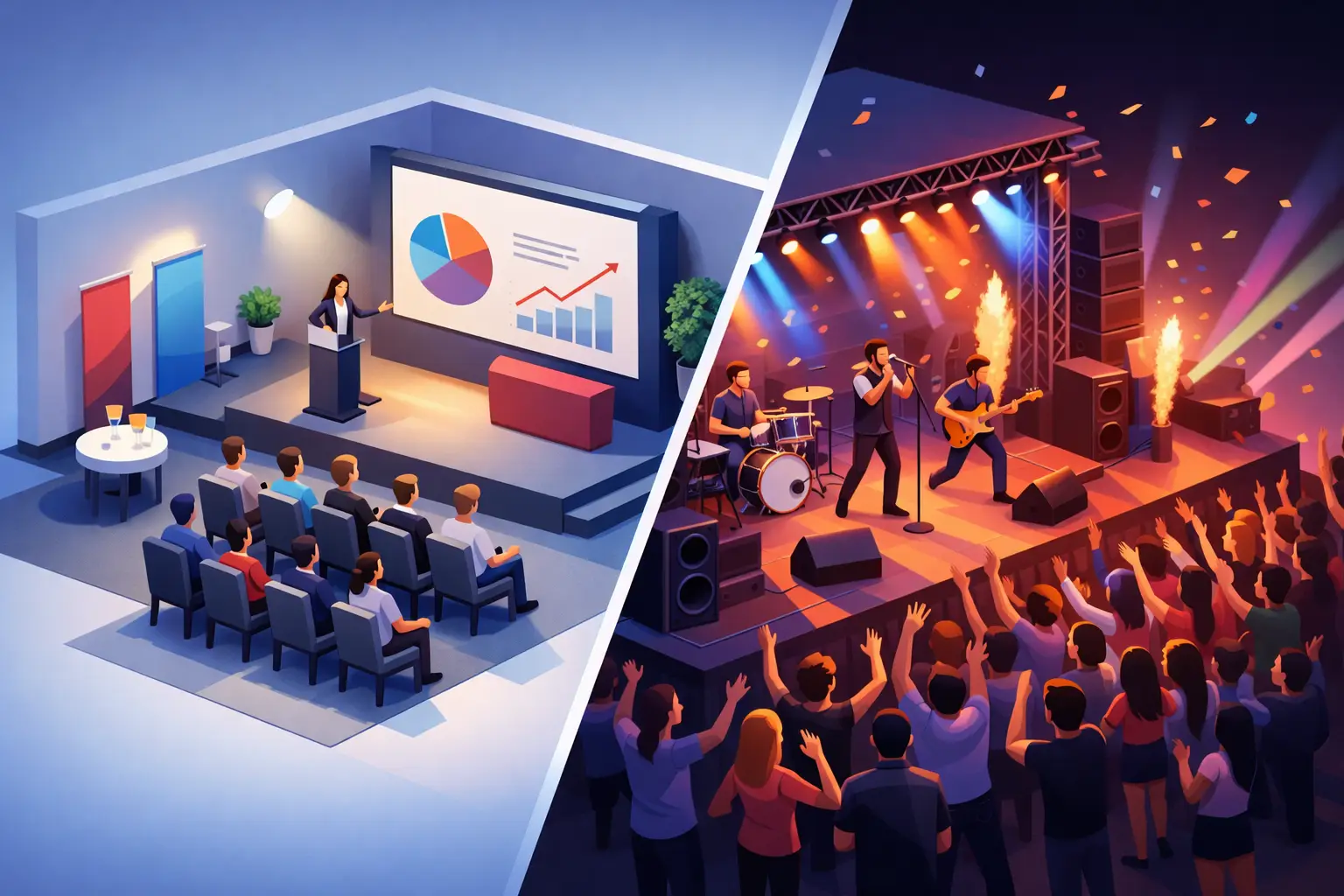
Difference Between Event and Concert
A sold-out live show and a 500-person corporate launch can both fill a venue, require staffing, and create crowd movement. But the difference between event and concert is not just wording. It affects planning, staffing levels, entry control, alcohol management, emergency response, and the kind of security presence a venue or organizer should put in place.
For venue operators, promoters, and operations teams, getting the definition right helps reduce risk before doors open. A concert is usually one type of event, but not every event behaves like a concert. That distinction matters when public safety, compliance, and reputation are on the line.
What is the difference between event and concert?
An event is a broad category. It can include conferences, trade shows, sporting functions, festivals, private parties, brand activations, award nights, community gatherings, and live performances. A concert is narrower. It is an event built around live musical performance for an audience.
In simple terms, all concerts are events, but not all events are concerts.
That sounds obvious until planning starts. Many operational problems begin when a client, venue, or supplier treats these two formats as if they carry the same crowd profile and control requirements. They do not. A networking event with timed arrivals and structured programming creates a different operating environment than a concert with queues, surges at entry, alcohol sales, loud sound, and synchronized crowd reactions.
Why the distinction matters in real operations
From a business standpoint, labels shape decisions. If you classify a booking as a general event when it is functionally a concert, you can under-resource security, underestimate crowd pressure, and miss predictable risk points.
Concerts tend to produce concentrated movement. Guests often arrive in shorter windows, gather close to the stage, and leave in large waves at the same time. Energy levels are higher. Noise affects communication. Lighting conditions can reduce visibility. If alcohol is involved, behavior can shift quickly.
A general event may still carry risk, but the pattern is often more spread out. Guests may move between rooms, spend time seated, follow a program, or engage in controlled activities. The crowd dynamic is usually less compressed, though there are exceptions. A product launch with celebrity talent, for example, can behave more like a concert than a standard corporate function.
This is where experienced planning matters. The format on paper is useful, but actual crowd behavior should drive the operating model.
A concert is a type of event, but it has its own risk profile
The clearest way to understand the difference between event and concert is to look at purpose and audience behavior.
A general event can be informational, social, promotional, ceremonial, or commercial. People may attend to meet clients, celebrate, learn, or represent a business. The atmosphere may be controlled and predictable, especially in corporate or ticketed private settings.
A concert is built around performance and audience response. People attend to watch, listen, react, and often participate through movement, singing, cheering, and crowd concentration near focal points. That changes the security equation.
Concerts typically require stronger attention to:
- queue management at entry points
- bag checks and prohibited items screening
- stage-front monitoring and crowd pressure
- alcohol-related incident response
- artist, VIP, and backstage access control
- coordinated egress at the end of the performance
Those needs can exist at other events too, but they are far more central to concert planning.
Planning differences between events and concerts
If you are organizing staffing, vendor coordination, or venue operations, the distinction affects almost every pre-event decision.
Crowd flow
At many business or private events, arrivals are staggered. Guests may check in over an hour or more, with a calmer pace at entry. At concerts, arrivals often spike hard before doors close or before the headline act starts. That can produce long lines, frustration, and gate pressure if screening is not properly resourced.
Inside the venue, a corporate event may encourage circulation. A concert often pulls the crowd toward one location. That creates pinch points around the floor, front-of-stage areas, bars, restrooms, and exits.
Security posture
An event may require a discreet security profile that reassures guests without dominating the environment. A concert often needs a more visible and more mobile deployment. Supervisors, floor teams, entry screening staff, roaming guards, and incident responders all play a larger role.
The right posture depends on the audience, venue design, alcohol service, performer profile, and expected attendance. A small acoustic set in a seated venue is different from a standing-room show with high-energy acts. It depends.
Access control
Many events involve layered guest categories such as staff, vendors, VIPs, speakers, and attendees. Concerts can have that same complexity, plus artist management, technical crews, restricted backstage areas, media access, and equipment movement windows that must be controlled tightly.
When access control slips, operational issues follow fast. Unauthorized backstage entry, overcrowded restricted zones, and confusion at credential checkpoints can all undermine safety and professionalism.
Emergency response
Any public gathering needs an emergency plan. Concerts usually demand more emphasis on crowd communication, extraction pathways, barrier management, and rapid coordination under loud, low-visibility conditions. In a concert setting, response time is not just about speed. It is also about being able to reach the issue through a dense crowd.
Common examples that blur the line
Some bookings sit between categories, which is why rigid definitions only go so far.
A music festival is clearly an event, but it includes multiple concerts and often carries layered risks from alcohol, weather, long operating hours, and large perimeter areas. A brand activation with live music may feel like a corporate event early in the evening and a concert later on once the performance begins. A community celebration with a headline act can shift from family-friendly open access to tightly controlled crowd management in a short period.
For planners, the better question is not only, “Is this an event or a concert?” It is, “How will people behave at each stage of this booking?”
That approach leads to better staffing, better positioning, and fewer surprises.
How security requirements change
Security planning should reflect actual exposure, not just the event label.
For a standard event, the focus may be on guest screening, asset protection, access control, and maintaining a calm, professional environment. For a concert, those responsibilities remain, but crowd control becomes more active. Teams may need to manage line buildup, monitor audience intensity, respond to intoxication, support medical access, and protect performers or VIP attendees.
This is where a tailored security model matters. A one-size-fits-all guard deployment can leave gaps. The stronger approach is to align staffing with attendance numbers, venue layout, entry design, event schedule, alcohol service, and audience profile. Broadsafe Group works in this operating reality every day, where visible deterrence, licensed personnel, and disciplined site planning help venues and organizers stay ahead of preventable incidents.
Choosing the right language when booking services
If you are requesting staffing from a security provider, venue partner, or operations team, clear language helps everyone scope properly.
Calling something an event is not wrong. It is just broad. If live music is the main attraction, if audience energy is expected to build around a performance, or if stage-front pressure is likely, say so early. That gives your provider a more accurate picture of risk, deployment needs, and supervision requirements.
It also helps with compliance. Different venue conditions, local requirements, and insurance expectations may apply depending on audience numbers, service of alcohol, performer profile, and hours of operation. Precision reduces the chance of under-planning.
The practical takeaway for organizers and venues
The difference between event and concert comes down to scope, purpose, and crowd behavior. An event is any organized occasion. A concert is a live music event with distinct operational demands.
That distinction matters because concerts often require tighter crowd control, more active floor supervision, stronger access management, and a faster incident response capability. General events may need less intensive control, but some can quickly take on concert-style risk depending on programming and attendance.
For decision-makers, the safest approach is to plan for behavior rather than rely on labels alone. If the crowd will queue hard, surge forward, drink heavily, gather around a stage, or exit all at once, treat that booking with concert-level discipline even if the invitation calls it an event.
A good plan starts with the right definition, but a safer outcome comes from asking the next question: what will this crowd actually do once the doors open?