Venue Security Planning Guide for Safer Events
A full room should feel energized, not unpredictable. Whether you operate a nightclub, hotel, concert hall, corporate facility, or temporary event site, a venue security planning guide gives your team a clear way to protect people without disrupting the guest experience. The strongest plans are built before doors open, when there is time to identify pressure points, assign authority, and prepare for the incidents that can escalate quickly in a crowded environment.
Security planning is not simply a question of how many guards to schedule. It is an operational decision that affects safety, compliance, customer service, staff confidence, and the reputation of your venue. A visible, professional security presence can deter misconduct. Just as importantly, trained personnel can recognize early warning signs and resolve issues before they become an emergency.
Start Your Venue Security Planning Guide With Risk
Every venue has a different risk profile. A daytime corporate conference, a late-night hospitality venue, a ticketed music event, and a VIP appearance may all use the same building, but they do not present the same challenges. Planning should begin with a site-specific risk assessment rather than a standard staffing template.
Consider who will attend, the expected attendance, event timing, alcohol service, performer or executive profile, public access points, parking arrangements, cash handling, and the history of incidents at the site. Also review factors outside the building. Nearby transit, construction, neighborhood activity, weather, and competing events can affect arrival patterns and emergency access.
The aim is to identify realistic scenarios and decide how the venue will respond. These may include intoxication, disorderly conduct, unauthorized entry, crowd surges, medical incidents, theft, evacuation, aggressive behavior, suspicious items, or a guest attempting to access a restricted area. Not every risk requires the same level of control. A proportional plan protects the operation without making the venue feel hostile or overmanaged.
Define What Security Is Responsible For
Confusion over responsibility creates delays when an incident occurs. The security plan should establish what security personnel will handle, what venue management retains responsibility for, and when police, fire, emergency medical services, or other authorities must be contacted.
For example, security may manage access control, identification checks, bag inspections where lawful and appropriate, queue management, patrols, incident reporting, and the initial response to disruptive conduct. Venue leadership should retain authority for business decisions such as stopping service, pausing an event, closing an area, or canceling a program. That division needs to be understood by every supervisor before the first guest arrives.
Build Staffing Around the Venue, Not a Headcount Formula
A guard-to-guest ratio can be useful as a starting point, but it is not a complete staffing model. Two venues with the same capacity can need very different coverage. A space with multiple entrances, a large outdoor perimeter, separate VIP rooms, loading docks, and parking areas requires a different deployment than a single-entry auditorium.
Map the venue by function. Identify entry and exit points, emergency exits, ticketing or reception, bars, cash offices, backstage areas, elevators, restrooms, parking facilities, loading areas, and any location where guests may gather or become separated from the main crowd. Then assign coverage according to the risk and the expected flow of people.
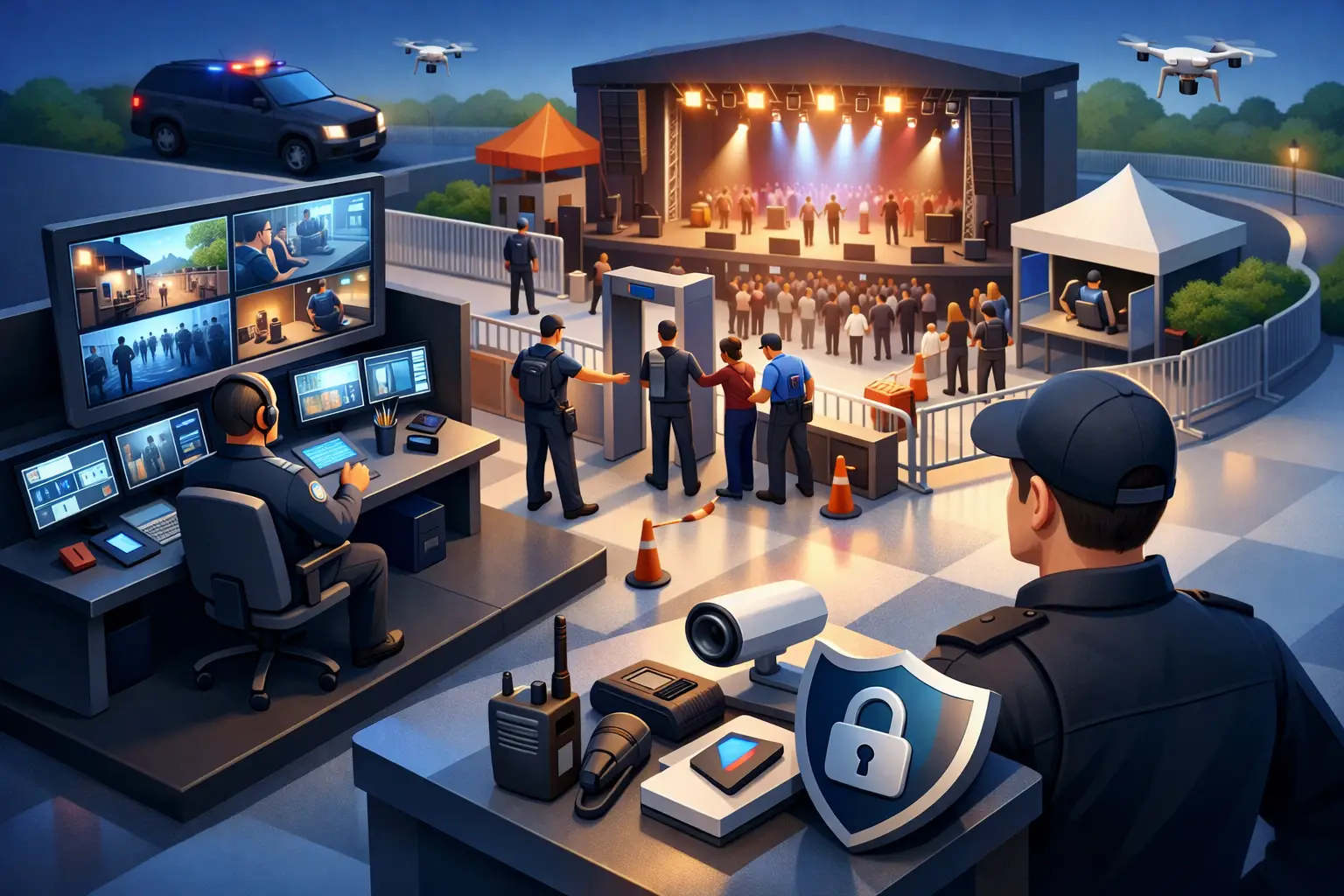
A well-designed deployment usually includes an accountable security supervisor, access-control personnel, roving officers, and staff positioned near higher-risk areas. Larger or higher-profile events may need a dedicated command point, VIP protection, vehicle screening, or an external perimeter presence. The right approach depends on the event, the venue layout, and the level of consequence if something goes wrong.
Personnel capability matters as much as staffing volume. Use properly licensed security professionals where required by local law, and confirm that they are trained for the assignment. A team experienced in corporate lobbies may not be the right fit for crowd control at a live performance. Hospitality environments also require officers who can communicate calmly with guests while maintaining firm boundaries.
Control Entry Without Creating Bottlenecks
The entrance is where security, customer service, and crowd behavior meet. A poorly managed line can create frustration, block sidewalks, expose guests to weather, and encourage people to bypass procedures. It can also make it harder for staff to identify suspicious behavior or prevent unauthorized access.
Set clear entry expectations before guests arrive. Signage, ticketing instructions, prohibited-item policies, dress requirements, age restrictions, and bag policies should be consistent with what staff enforce at the door. If the rules change from one person to the next, guests will challenge the process and pressure builds quickly.
Create separate lanes when practical for ticket holders, credentialed staff, VIPs, deliveries, and accessible entry. Keep emergency exits free from queues and ensure that security teams can communicate with ticketing, reception, and venue management when lines begin to build. For some events, staggered arrival times or early door opening can reduce the peak load significantly.
Screening procedures should be lawful, respectful, and appropriate to the risk. Excessively intrusive measures can damage the guest experience and slow entry without delivering meaningful protection. On the other hand, inadequate screening at a high-risk event can leave staff and attendees exposed. The decision should follow the risk assessment, not a one-size-fits-all policy.
Create Clear Communications and Escalation Paths
A security plan only works when the right people receive the right information quickly. Establish a communication method for security, venue management, operations, medical staff, and event organizers. Radios are often the most reliable choice for active venues, but they need assigned channels, concise radio protocols, spare batteries, and a plan for dead zones.
Before opening, hold a briefing that covers staffing positions, event schedule, known concerns, emergency exits, evacuation routes, key contacts, restricted areas, and escalation procedures. Give the team simple language for urgent requests. Staff should know who has the authority to call for additional support, contact emergency services, or initiate an evacuation.
Communication also needs to be documented after the event. Accurate incident reports support follow-up, insurance matters, internal reviews, and future planning. Reports should state observable facts, actions taken, witnesses, time stamps, and any handover to management or authorities. Opinions and unnecessary language can undermine an otherwise useful record.
Plan for Emergencies Before They Feel Urgent
Fire alarms, medical calls, severe weather, power loss, and security threats require different responses, but they share one requirement: people need direction. Your plan should identify assembly areas, evacuation routes, access for first responders, and the process for accounting for staff and contractors.
Walk the routes instead of relying only on floor plans. Check that exit signage is visible, gates can be opened as intended, pathways are clear, and emergency vehicles have access. For outdoor events, account for ground conditions, temporary structures, lighting, and the ability to move attendees to shelter.
Practice matters. A short pre-event walkthrough with management, security, and key operational staff will expose practical issues that a written plan can miss. It may reveal that a door sticks, a radio channel is unclear, or a designated assembly area conflicts with vehicle traffic. Correcting those issues before an event is far easier than improvising in front of a crowd.
Protect People While Preserving the Guest Experience
Effective security should be visible enough to reassure guests and discreet enough to let the venue operate as intended. Officers should be approachable, professionally presented, and able to give directions without escalating tension. The best intervention is often early, respectful, and low-profile.
This is especially relevant in hospitality and entertainment settings. Removing a disruptive guest may be necessary, but it should be managed with a clear process, sufficient staff support, and attention to the safety of surrounding patrons. Force should never be the default response. De-escalation, distance, communication, and supervisor involvement can often prevent an incident from becoming more serious.
The same principle applies to VIPs, performers, and executives. Protection plans should preserve privacy and movement while controlling access to sensitive areas. High-profile guests can attract attention well beyond the event itself, so arrival routes, departure timing, credentialing, and backstage access deserve advance coordination.
Review Every Event and Improve the Next One
Security planning is not finished when the last guest leaves. Conduct a short debrief with security leadership and venue management while details are still fresh. Review incidents, arrival flow, staffing positions, communication gaps, guest complaints, medical calls, and areas where personnel were either overstretched or underused.
Patterns matter. Repeated disputes near one bar, congestion at a particular exit, or unauthorized access through a service corridor are signals that the operating plan needs adjustment. Small changes to barriers, lighting, staffing times, or access procedures can reduce risk substantially at the next event.
A dependable security partner brings disciplined personnel and a tailored plan, but the most valuable outcome is operational confidence. When your team knows who is responsible, how concerns are escalated, and where support will be positioned, the venue can focus on delivering the experience guests came for.