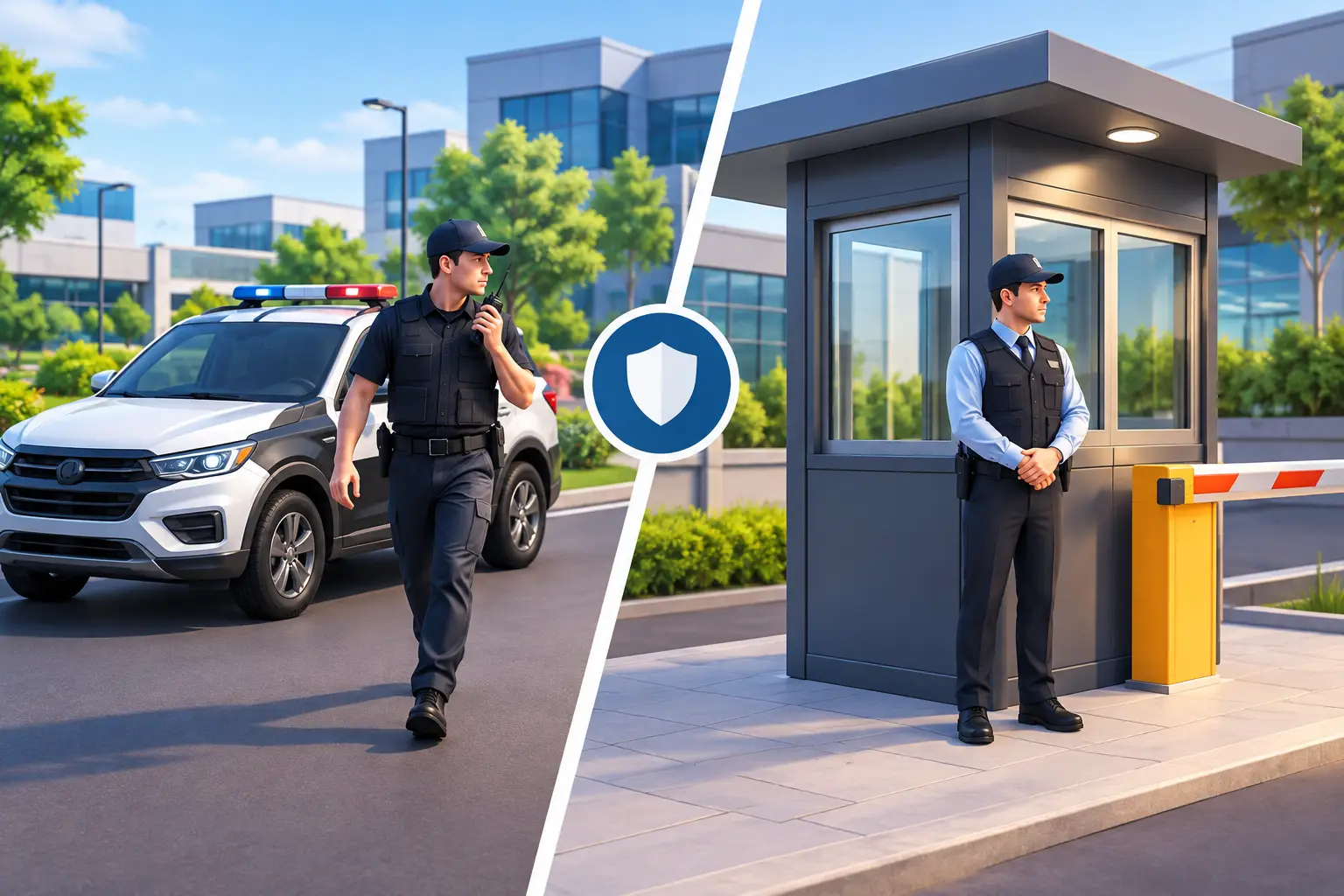
Mobile Patrol vs Static Guards – Which Is Right?
A guard at your front entrance may discourage unwanted behavior, but it cannot inspect a rear loading dock, walk a perimeter, or respond to an alarm across a large property at the same time. That operational reality sits at the center of the mobile patrol vs static guards decision.
For site managers, venue operators, and facilities teams, the right choice is not simply about placing security personnel on-site. It is about matching coverage, visibility, response expectations, and budget to the risks your operation actually faces. A well-designed security plan protects people and assets without creating unnecessary gaps or paying for coverage that does not serve the site.
Mobile Patrol vs Static Guards: The Core Difference
Static guards are assigned to a fixed location or defined area for a scheduled period. They may control access at a lobby, monitor a gatehouse, supervise a loading entrance, manage a crowd line, patrol a single venue floor, or remain close to a high-value asset. Their presence is continuous and visible.
Mobile patrol officers move between locations or conduct scheduled and randomized checks across a property or portfolio of properties. Depending on the assignment, they may inspect doors, gates, fencing, lighting, parking areas, equipment yards, vacant buildings, and alarm points. They can also provide lock and unlock services, attend alarm activations, document incidents, and escalate concerns according to agreed procedures.
Neither model is automatically better. Static guarding offers dedicated oversight in one place. Mobile patrol provides wider reach and flexibility. The strongest decision begins with a clear picture of where incidents are most likely to occur and how quickly an officer must be able to intervene.
When Static Guards Are the Better Choice
Static guarding is generally suited to locations where people, access points, or sensitive operations require constant attention. A corporate reception desk, construction site gate, hospital entrance, hotel lobby, nightclub door, or event credential checkpoint all benefit from an officer who is consistently present.
The visible deterrent is a major advantage. People are less likely to test access controls, create disturbances, or behave aggressively when a professional guard is positioned at the point of contact. For hospitality and event environments, a static officer also supports the customer experience by providing directions, handling entry procedures, and de-escalating concerns before they affect other guests.
Static guards are particularly valuable when a delayed response is unacceptable. If an unauthorized person attempts to enter a controlled area, a guard already stationed there can challenge, deny entry, and notify management or emergency services immediately. This is difficult to replicate with periodic patrols.
However, fixed coverage has a practical limitation: the officer can only be in one place. A guard at the front gate may not notice activity behind a warehouse, near a fuel storage area, or in a distant parking lot. Large sites with multiple vulnerable points may need additional officers, patrol support, cameras, or access-control measures to avoid blind spots.
Common uses for static guarding
Static guards are often selected for high-footfall venues, offices receiving visitors, active construction gates, retail premises, clubs and bars, hotels, high-profile functions, and sites where entry screening is required. They are also appropriate when a client needs a familiar on-site point of contact for staff, contractors, guests, and emergency responders.
When Mobile Patrol Is the Better Choice
Mobile patrol is often the more efficient option for properties that are closed overnight, spread across a large area, or exposed to risks that can be managed through regular inspection. Examples include industrial yards, commercial buildings after hours, vacant premises, storage facilities, schools, apartment complexes, and multi-site business portfolios.
Rather than paying for a guard to remain at one location for an entire shift, a patrol officer can inspect several critical points at planned intervals. The unpredictable timing of randomized checks can also make it harder for offenders to identify a routine. Patrol officers can verify that doors and gates are secure, look for signs of forced entry or damage, identify safety hazards, and report issues before they become costly disruptions.
Mobile patrol works best when response expectations are realistic. If the concern is checking that a site remains secure during non-operational hours, periodic attendance may be highly effective. If the concern is preventing an aggressive incident at a busy entrance, a patrol officer who arrives after a call will not provide the same level of protection as a static guard already on location.
The quality of the patrol program matters. Clear patrol instructions, documented checkpoints, reliable communication, incident reporting, and escalation procedures turn patrol attendance into accountable security coverage. Without defined expectations, a patrol service can become little more than an occasional drive-by.
Cost Should Be Measured Against Risk
Budget is a legitimate consideration, but the lowest hourly rate does not always produce the lowest overall risk. Static coverage generally requires a greater investment because an officer is dedicated to your site for the duration of the shift. For a location that needs continuous access control or immediate intervention, that cost is often justified.
Mobile patrol can reduce costs where continuous guarding is not necessary. It allows businesses to direct security resources toward targeted inspections, alarm response, opening and closing procedures, or checks at several locations. This can be especially practical for organizations managing multiple low-occupancy sites.
The key is to avoid using patrol as a substitute for static coverage where the risk demands an on-site presence. A single theft, safety incident, unauthorized entry, or disruption to operations can outweigh apparent savings. Consider the potential impact on staff safety, customer confidence, insurance exposure, property damage, and business continuity alongside the guard rate.
A Hybrid Model Often Delivers Better Coverage
Many sites benefit from combining both services. A distribution facility, for example, may place a static guard at the gate during delivery hours while using mobile patrols to inspect the perimeter and equipment areas overnight. An event venue may use static officers at entrances, backstage access points, and crowd pressure areas, while mobile officers circulate through parking areas and less visible sections of the site.
This approach assigns people where they have the greatest preventive value while keeping broader areas under active observation. It also gives supervisors more flexibility when conditions change. If an event attracts higher attendance than expected or a construction project expands into a new work zone, coverage can be adjusted around the emerging risk.
For multi-site organizations, the hybrid model can include static guards at the most sensitive location and mobile patrol coverage for the remaining properties. The result is a security plan that reflects the real hierarchy of risk rather than treating every location as identical.
Questions to Ask Before Choosing Security Coverage
Start with the operational facts. How many entry points exist? Are staff, customers, contractors, or members of the public on-site? What time of day presents the highest risk? How quickly must security intervene if there is a problem? Is the site large enough that one officer cannot reasonably observe it from a fixed post?
Also consider the nature of the threat. Theft, trespass, vandalism, workplace conflict, crowd behavior, unauthorized access, and alarm response each require a different security posture. A venue dealing with intoxicated patrons needs experienced, visible personnel who can communicate calmly and act decisively. A closed industrial site may need disciplined perimeter checks, clear reporting, and rapid escalation after an alarm.
Finally, ask what evidence and accountability you need from your provider. Professional security coverage should include licensed personnel as required, clear post orders, reliable communication, incident documentation, and a defined chain of escalation. These details are what make a security presence dependable when an issue occurs.
Build the Plan Around the Site, Not the Service Label
Mobile patrol and static guarding are tools, not competing labels that must be chosen in isolation. The right arrangement depends on the site layout, operating hours, public exposure, asset value, and required response time.
Broadsafe Group develops tailored security coverage for venues, commercial operations, events, and sites that need professional, accountable personnel. Whether the requirement is a constant on-site presence, scheduled patrol activity, or a combination of both, the most effective solution is the one that gives your people and property the right protection at the moments it matters most.