Best Security Setup for Hotels That Works
A hotel security failure rarely begins with a dramatic incident. More often, it starts with a propped-open staff door, an unattended front desk, a guest who follows someone into a restricted elevator, or a disturbance that staff are not equipped to de-escalate. The best security setup for hotels addresses these everyday gaps before they affect guests, employees, operations, or the property’s reputation.
For hotel owners and operations managers, security should feel present without making the property feel hostile. The goal is a professional, visible, and well-coordinated security operation that protects people while preserving the welcoming experience guests expect.
The Best Security Setup for Hotels Starts With Risk Assessment
No two hotels have the same risk profile. A 24-hour airport hotel, a boutique downtown property, a resort with multiple pools and parking areas, and a venue hotel hosting weddings or conferences all need different coverage.
A proper assessment looks beyond the lobby. It considers guest entry points, loading docks, employee entrances, parking structures, elevators, stairwells, back-of-house corridors, cash handling areas, bars, restaurants, and event spaces. It should also account for the hours when the property is most exposed. For many hotels, that means late evening, overnight shifts, check-in peaks, large event arrivals, and closing time at an on-site bar or restaurant.
The assessment should identify what is most likely to happen, not only what would be most serious. For example, unauthorized access, guest disputes, theft from vehicles, intoxication-related incidents, and welfare concerns may be more frequent than a major emergency. A capable security plan prepares for both.
Build Security in Layers, Not Around One Guard
A single officer at the front door can be useful, but it is not a complete hotel security strategy. Effective coverage is layered so that a problem can be detected, assessed, and addressed before it spreads.
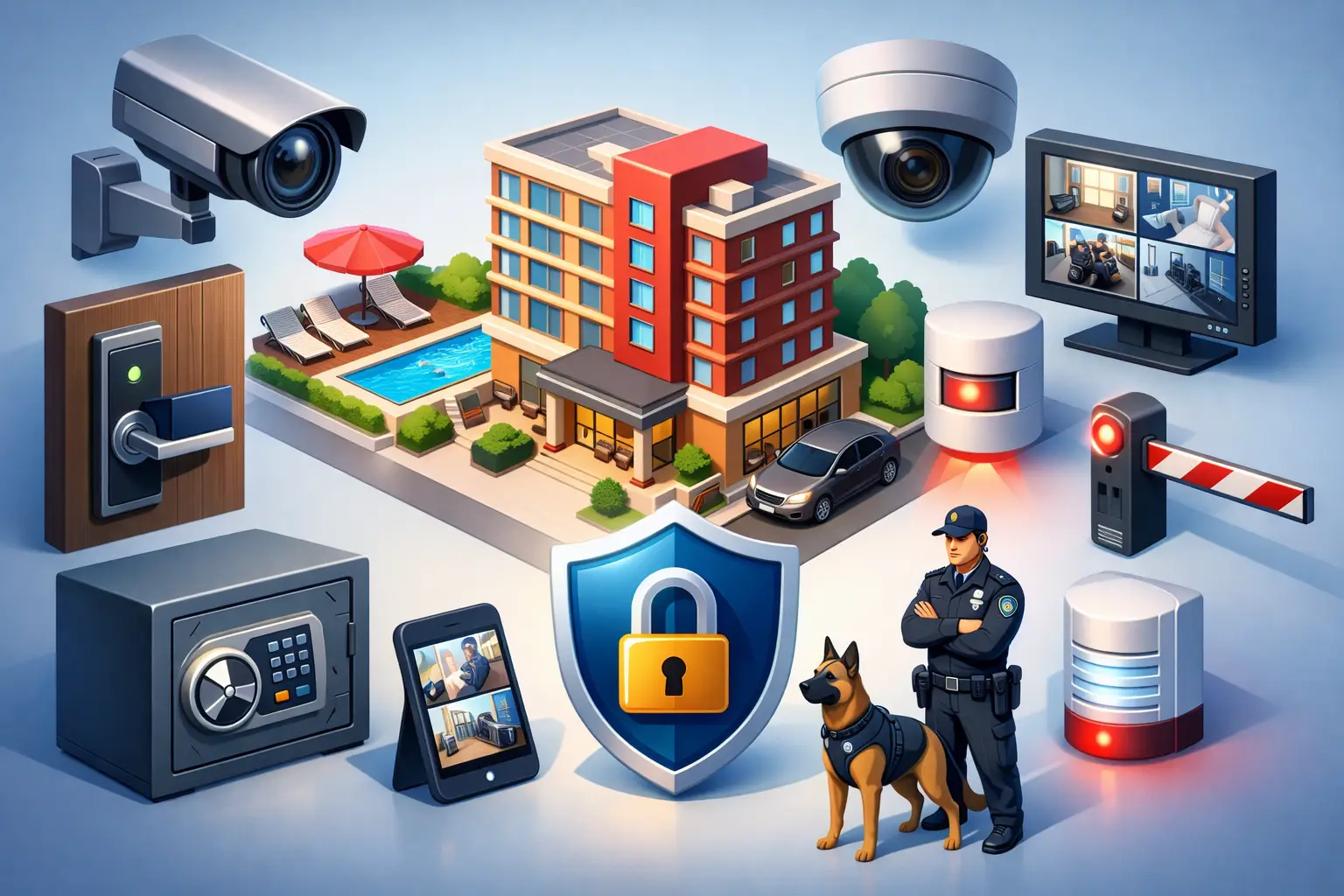
The core layers typically include:
- Trained security personnel positioned where visibility and response matter most
- Controlled access to guest floors, staff-only areas, and high-value spaces
- Cameras that cover entrances, elevators, corridors, parking areas, and blind spots
- Clear reporting and escalation procedures for staff, management, and emergency services
- Regular patrols that make security visible across the entire property
These elements work best when they support one another. Cameras may identify an issue, but trained personnel must interpret what they see and respond appropriately. Access control can restrict entry, but a secure door is ineffective if it is routinely left open for convenience. Patrols deter misconduct, but they must be documented and timed around the property’s real operating risks.
Put the Right Security Personnel in the Right Places
Hotels need personnel who understand hospitality as well as security. A security officer may be the first person a distressed guest approaches, the person who manages an intoxicated patron, or the professional asked to handle a sensitive domestic dispute. Their conduct directly affects guest confidence and online reputation.
Front-of-house security should be approachable, well-presented, and alert. Officers assigned to lobbies, entrances, and event areas need strong communication skills and the judgment to distinguish between a guest who needs assistance and behavior that requires intervention.
Back-of-house and overnight coverage often requires a different focus. These assignments may involve checking access points, monitoring parking areas, escorting employees, responding to alarms, conducting welfare checks, and maintaining incident records. In larger hotels, a mobile patrol officer can provide broader coverage while a dedicated officer remains available at the lobby or control point.
The right staffing level depends on the size and layout of the hotel. It also depends on occupancy, event schedules, alcohol service, neighborhood activity, and whether the property operates around the clock. Cutting overnight coverage may appear efficient until one incident exposes the lack of response capacity.
Licensing, Training, and Professional Standards Matter
Hotel management should verify that security personnel are properly licensed for the jurisdiction, insured, and trained for the assignment. Generic guarding experience is not always enough. Hospitality security teams should understand customer service, conflict de-escalation, incident reporting, emergency response, and appropriate communication with hotel management.
Professional presentation also matters. Guests should be able to identify security easily, while officers should fit the property’s environment. A luxury hotel may require a discreet style of presence, while a busy entertainment hotel may benefit from more visible staffing at key times.
Control Access Without Creating Friction
Most hotel security issues involve access in some form. Someone enters a guest floor without authorization, a former employee still has credentials, a delivery person reaches a restricted area, or an exterior door is not secured after hours.
Guest-floor access control, such as keycard-operated elevators or floor-entry doors, is one of the strongest practical measures a hotel can implement. It reduces casual unauthorized movement and gives staff a clearer basis for challenging access when necessary.
Staff access should be managed just as carefully. Limit keys, cards, and codes to the people who need them, review permissions when roles change, and deactivate credentials immediately when employment ends. Master keys and access cards require a documented chain of custody. Losing control of them creates a serious operational risk.
Delivery and contractor procedures are equally important. Vendors should use designated entrances, sign in when appropriate, wear identification, and remain within approved work areas. These steps may seem routine, but they prevent the hotel from becoming an open workplace with unknown movement through sensitive areas.
Use Technology to Support Decisions, Not Replace Them
Modern systems can substantially improve hotel security, especially when a property has multiple entrances or large grounds. Cameras, access-control records, alarm monitoring, intercoms, and incident-management tools create useful visibility. However, technology only delivers value when people know how to use it and there is a clear response process.
Camera coverage should prioritize entrances, reception areas, elevator lobbies, parking facilities, cash points, loading areas, and exterior boundaries. Avoid treating cameras as a substitute for patrols. A camera may record an incident, but it cannot provide reassurance to a guest, separate a conflict, or secure an unsafe area.
The same principle applies to access alerts and alarms. If a door alarm activates repeatedly without follow-up, employees quickly learn that it does not matter. Every alert needs ownership, whether that is hotel management, a control room, or on-site security.
Hotels with limited internal resources can benefit from a security partner that combines physical coverage with technical support. The advantage is not adding technology for its own sake. It is ensuring systems, personnel, and reporting operate as one service model.
Prepare Staff for the First Few Minutes
Security officers are essential, but hotel employees are often first to notice a concern. Front desk staff may observe suspicious behavior. Housekeeping teams may identify unsecured rooms or welfare issues. Food and beverage employees may see a guest becoming increasingly intoxicated or aggressive.
Every department should know how to raise an alert, what information to provide, and when not to intervene alone. A simple internal protocol helps: identify the location, describe the issue, contact the designated responder, and protect the privacy of everyone involved. Staff should not be expected to physically manage violence, threats, or complex disputes without trained support.
Regular scenario-based briefings are more useful than a policy document that is never revisited. Walk through likely situations such as an unauthorized person on a guest floor, a missing child report, a medical emergency, an aggressive guest, a parking-lot incident, or a fire evacuation. Clear roles reduce hesitation when time matters.
Treat Events, Bars, and Busy Periods as Separate Operations
A hotel can operate safely on a normal weekday and still be exposed during a wedding reception, conference, holiday weekend, or major sporting event. Higher occupancy and alcohol service change the risk profile quickly.
For these periods, security should be planned around guest flow. Consider where queues form, how attendees enter and exit, where rideshare pickups occur, which areas need restricted access, and how security will communicate with event organizers and hotel management. A visible officer near a ballroom entrance may prevent gatecrashing and reduce disruptive behavior before it reaches guest rooms.
Crowd management should be proportionate. Excessive intervention can damage the event experience, while insufficient coverage can leave staff overwhelmed. The balance comes from trained personnel, clear event instructions, and a plan that matches the expected audience.
Measure Performance Through Reporting and Review
A hotel security provider should do more than fill shifts. Management needs reliable reporting that shows patrol activity, incidents, response actions, recurring issues, and recommendations for improvement.
Reports help identify patterns that are easy to miss during daily operations. Repeated alarms at one door, vehicle break-ins in a specific area, frequent disturbances near a bar, or recurring access issues on a guest floor all point to a problem that can be corrected.
Review security coverage after major incidents, seasonal changes, renovations, and large events. The best plan is not fixed forever. It adapts as the property, guests, and operating conditions change.
A hotel earns trust through hundreds of small interactions. When guests see attentive professionals, secure access points, and staff who know how to respond, they can focus on why they came. That confidence is one of the most valuable services a hotel can provide.