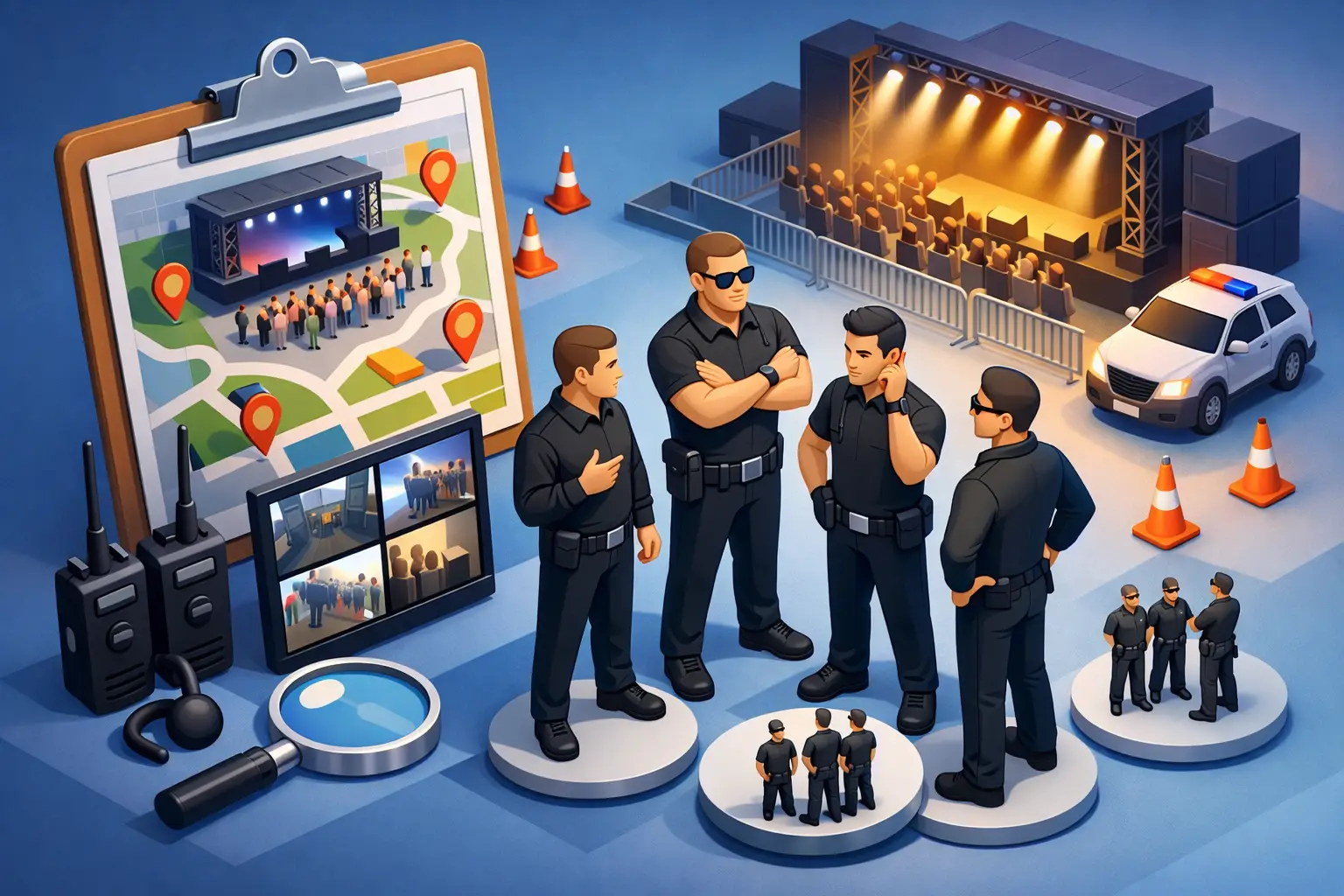
How Many Guards Does an Event Need?
A 200-person networking night and a 2,000-person live music event can both ask the same question – how many guards does an event need – and still arrive at very different answers. Headcount matters, but it is only one part of the staffing decision. Venue layout, alcohol service, entry screening, guest profile, event timing, and emergency planning all affect how many licensed security professionals you should have on site.
If you under-resource security, the pressure shows up quickly. Lines back up at entry, incidents take longer to contain, restricted areas become harder to control, and staff end up reacting instead of managing. If you overstaff without a clear plan, you add cost without improving safety. The right number is the one that matches your risk profile, supports smooth operations, and gives your team the coverage to respond early rather than late.
How many guards does an event need? Start with risk, not guesses
There is no single universal formula that works for every event. Some organizers want a simple ratio, but experienced planning starts with a risk assessment. A low-key corporate function in a controlled venue may need only a small team for access control and a visible presence. A public event with open access, alcohol, cash handling, VIPs, or a late finish may require a larger deployment with clearly assigned zones.
The first question is not how many attendees are expected. The first question is what security must actually do during the event. If guards are checking credentials, screening bags, monitoring crowd movement, securing back-of-house areas, escorting VIPs, managing parking, and handling incident response, one number alone will not cover all of that. You need staffing based on tasks as well as attendance.
That is why serious event security planning looks at the full operating picture. Crowd control, emergency exits, perimeter strength, traffic flow, vendor access, stage protection, and post-event egress all need to be considered before finalizing numbers.
The main factors that determine guard numbers
Attendance is still a major factor, because larger crowds create more pressure on entry points, amenities, exits, and common areas. But the same crowd size can demand very different coverage depending on the format. A seated conference is easier to manage than a standing concert. A ticketed gala has different risks than a public street activation.
Alcohol service is another major driver. Events where guests are drinking typically need more active monitoring, faster intervention capability, and stronger crowd management, especially later in the evening. The same applies to events with a younger crowd, a high-energy entertainment component, or a history of disorderly behavior.
Venue design also changes the staffing requirement. A compact indoor venue with one controlled entrance may need fewer guards than a spread-out site with multiple access points, loading areas, parking zones, and external gates. If your event has blind spots, long perimeters, or mixed public and restricted spaces, staffing needs rise quickly.
Then there is the operational layer. If your team needs guards for credential checks, bag screening, roaming patrols, control room support, asset protection, artist or executive escort, and emergency response, each function needs coverage. In many cases, the number of guards is shaped less by crowd size than by how many simultaneous responsibilities exist.
Typical staffing scenarios for different events
For a small private event, such as a corporate reception, product launch, or invitation-only function, security may be limited to front entry control and one or two roaming professionals. In that setting, the goal is often deterrence, guest screening, and quick response if a problem develops.
For medium-sized events, staffing usually becomes more layered. You may need personnel at entry and exit points, one or more guards dedicated to roaming inside the venue, and a supervisor to coordinate responses and maintain communication with organizers. If alcohol is being served or guest numbers are rising into the hundreds, this level of structure becomes much more important.
Large public events often require a fuller security plan with zone-based coverage. That can include gate teams, perimeter guards, pit or stage-front security, VIP protection, parking lot monitoring, and response staff who are not tied to one static post. Once crowd density increases, visible positioning and communication discipline become critical.
The key point is that staffing should reflect coverage needs across the site, not just a total headcount. Ten guards in the wrong places can leave serious gaps. A smaller but well-positioned team can sometimes perform better if the event is properly designed and managed.
When event type changes the answer
A concert typically needs more security than a conference of the same size. The reason is straightforward: movement, noise, crowd surges, artist protection, and late-night exit patterns all increase the operational load. Guards may need to manage front-of-stage behavior, prevent unauthorized access backstage, and respond quickly in crowded conditions.
Sporting events and community festivals also tend to require broader deployment. Multiple entry points, family groups, food and beverage areas, temporary fencing, and open public access create a wider security footprint. Even where the crowd is well behaved, the site itself demands more eyes and more control points.
By contrast, a private executive event may have a smaller visible team but still require highly capable personnel. If the event includes senior leadership, public figures, or sensitive business activity, the focus shifts from crowd volume to discretion, access control, and protective coverage.
Why entry points and exits often decide staffing
If organizers ask how many guards does an event need, the answer is often hiding at the front gate. Entry management is where delays, tension, and unauthorized access start. If guests need ID checks, ticket scanning, bag inspection, or wristband verification, staffing must be strong enough to keep people moving without losing control.
Exits matter just as much. Security is not only about who gets in. It is also about how people leave. At closing time, crowds compress, patience drops, and traffic outside the venue can become part of the risk. If security is stretched too thin during egress, minor issues can escalate fast.
This is why experienced event planners do not count only the crowd inside the venue. They also account for arrival patterns, line management, smoking areas, rideshare pickup zones, and parking flow.
The value of supervisors and specialized roles
Not every security team should be made up only of general guards. Once an event reaches a certain size or complexity, supervision matters. A working supervisor helps maintain communication, reassign resources, document incidents, and coordinate with venue management or emergency services if needed.
Specialized roles may also be necessary. Some events require dedicated crowd controllers, close protection officers, gate screeners, or personnel assigned to restricted areas. This can increase staffing numbers, but it also improves control. Asking one guard to handle multiple critical tasks at once is where coverage gaps begin.
Professional providers build teams around the event, not just the schedule. That means assigning the right mix of static coverage, mobile presence, and command oversight for the environment.
Cost matters, but under-staffing costs more
Budget pressure is real, especially for recurring events and multi-site operations. Still, security is one of the few event costs that directly affects safety, reputation, and legal exposure. A short-staffed event can lead to preventable incidents, delayed responses, property damage, guest complaints, and operational disruption.
Well-planned staffing protects more than the venue. It protects the guest experience. Attendees notice when an event feels orderly, well managed, and professionally controlled. They also notice when entry is chaotic, restricted areas are unsecured, or incidents are handled slowly.
That does not mean every event needs a large team. It means staffing should be justified by real operating conditions, not reduced to an arbitrary minimum.
A practical way to decide what you need
Start with the basics: expected attendance, venue layout, number of access points, alcohol service, event hours, guest profile, and whether the event is public or private. Then define the actual security tasks. Who is controlling entry? Who is watching the floor? Who handles backstage or executive areas? Who responds if an incident happens in the parking lot while another issue is unfolding inside?
From there, build coverage by zone and by function. This approach gives you a clearer answer than any generic ratio. It also gives your provider enough information to recommend staffing that is realistic, compliant, and fit for purpose.
For organizers who want reliability, this is where a professional security partner adds real value. A company like Broadsafe Group does not treat event staffing as a simple headcount exercise. It is planned around risk, visibility, response capability, and the specific demands of the venue and crowd.
The better question is not only how many guards you need. It is whether your event has the right coverage in the right places at the right time. When that part is handled properly, the event runs calmer, your team operates with more confidence, and your guests can focus on why they came in the first place.