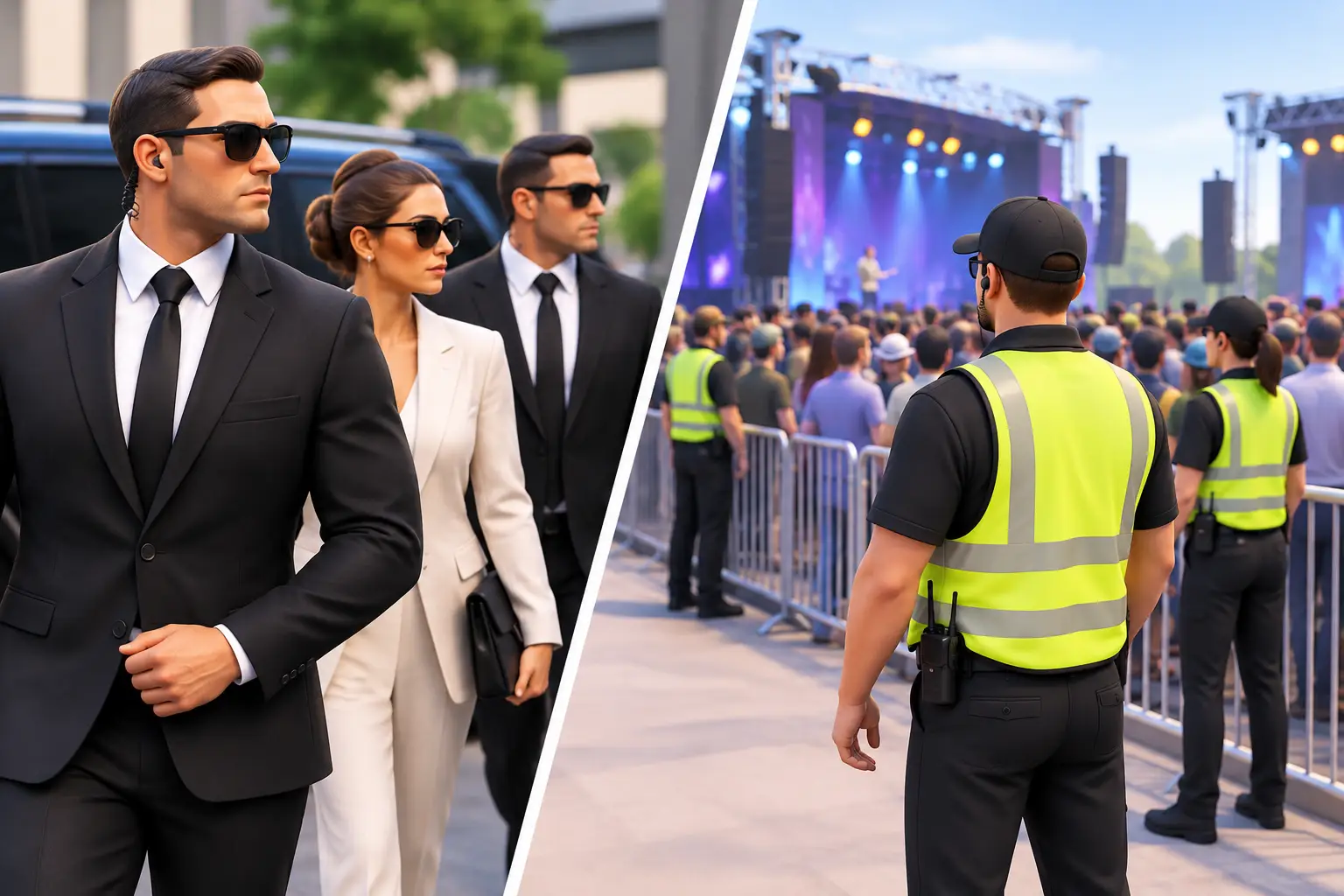
Bodyguards vs Event Security Teams: Which Fits?
A VIP arriving through a public entrance, a packed concert floor, and a corporate event with sensitive guests may all require security. But the right answer is rarely simply “more guards.” When comparing bodyguards vs event security teams, the decision comes down to what must be protected, where the exposure sits, and how quickly a situation could affect people, operations, or reputation.
A close-protection professional and an event security team can work together effectively, but they are built for different responsibilities. Choosing the wrong model can leave gaps in guest screening, crowd movement, executive privacy, emergency response, or access control.
Bodyguards vs Event Security Teams: The Core Difference
A bodyguard, also called a close-protection officer or personal protection specialist, is assigned primarily to a person. Their focus is the safety, movement, privacy, and immediate environment of a specific client, executive, family member, speaker, performer, or other high-profile individual.
An event security team is assigned primarily to a place and its operations. The team protects entrances, exits, restricted areas, staff, guests, equipment, cash points, backstage areas, and the broader flow of the event. Their work is designed to reduce risk across a venue rather than remain centered on one individual.
This distinction matters because visibility can be misleading. A highly visible guard at the front door may provide a strong deterrent, but that person is not necessarily positioned to manage an executive’s movement from vehicle to green room. Likewise, a close-protection officer staying with a principal cannot also supervise a busy entry line, respond to a dispute at the bar, and monitor emergency egress routes.
When Personal Protection Is the Better Fit
Bodyguards are most appropriate when a person faces a defined or elevated risk. That risk may be related to public recognition, contentious business matters, media interest, a known threat, travel patterns, family concerns, or an event that creates close public contact.
The assignment usually begins before the principal arrives. A professional protection plan considers arrival and departure points, vehicle access, hotel or office entry, venue layouts, holding areas, public exposure, and communication protocols. The goal is not to create unnecessary attention. It is to keep the person moving safely and confidently while allowing the engagement to proceed as planned.
Personal protection is often valuable for executives attending high-profile meetings, artists moving between backstage and public areas, keynote speakers, athletes, and VIP guests. In some cases, a discreet plainclothes approach is best. In others, a visible presence at the principal’s side provides reassurance and discourages unwanted contact.
A bodyguard is not automatically the right choice because someone is important. If the main concern is theft, gatecrashing, intoxicated patrons, or a large crowd moving through a venue, event staffing may address the actual risk more effectively and at a more sensible cost.
When an Event Security Team Is the Better Fit
Event security teams are designed for environments with multiple moving parts. Concerts, conferences, festivals, club nights, product launches, hospitality events, trade shows, and corporate functions all create operational risks that extend well beyond one guest.
A properly staffed team can manage access points, verify credentials, direct queues, patrol internal and external areas, monitor crowd behavior, protect restricted zones, and respond to incidents. Security personnel can also support venue staff by addressing issues early, before a disagreement, access breach, or overcrowded area becomes a larger disruption.
For event organizers, this broad coverage is often essential. A single guard cannot safely cover a loading dock, main entrance, VIP room, stage door, and emergency exit. The correct team size and deployment depend on attendance, venue design, alcohol service, event duration, performer profile, traffic flow, and the history of similar events.
Crowd control is particularly important where guests are arriving in waves or where excitement can quickly change crowd behavior. Effective teams are not just stationed around the site. They are positioned with a purpose, briefed on escalation procedures, and connected by clear communication.
The Overlap: VIP Areas Need Both
Many events need a combined model. A concert may require an event security team to manage entry screening, crowd control, backstage access, and emergency routes, while dedicated close-protection personnel stay with an artist or executive. A corporate gala may need venue-wide guards alongside personal protection for a high-profile guest.
In these situations, role clarity is critical. The bodyguard should not be pulled away to handle routine crowd issues, and event guards should understand the principal’s approved routes, secure zones, and movement schedule without receiving unnecessary personal details.
A shared briefing helps prevent conflicting decisions. Everyone should know who leads on a personal protection incident, who controls venue evacuation procedures, how information is escalated, and where the command point sits. This coordination protects the client without disrupting the event experience for other attendees.
How to Assess Your Security Requirement
The best security plans are based on a practical risk assessment, not assumptions. Start by identifying the primary asset at risk. Is it a person, a venue, a crowd, sensitive information, equipment, or business continuity? Then consider how that risk could emerge.
For example, a CEO attending a low-attendance private meeting may benefit from discreet personal protection and controlled access. A 2,000-person music event requires a different approach, with staffing across entrances, public areas, backstage zones, and exits. A public appearance by a celebrity at that same music event may require both.
Ask these questions before engaging a provider:
- Is there a specific person who needs dedicated protection throughout the assignment?
- How many access points, restricted zones, and public-facing areas need coverage?
- Will alcohol, large crowds, media, cash handling, or late-night operations increase the risk?
- What happens if an incident occurs: who responds, who communicates, and who keeps the event operating?
- Does the security provider have the licensing, insurance, supervision, and staffing capacity for the assignment?
The answers should guide the deployment model. They also help set realistic expectations. Security reduces risk, but no provider should promise that every incident can be prevented. What professional planning can do is identify vulnerabilities, establish control measures, and ensure trained personnel are ready to respond.
Staffing Levels Are About More Than Headcount
A low quote based only on the number of guards can be misleading. The value of an event security team depends on where personnel are placed, what they are authorized to do, their experience with the venue type, and how they are supervised. The same is true for personal protection, where discretion, judgment, communication skills, and advance planning matter as much as physical presence.
For a venue operator, staffing should account for breaks, shift duration, peak arrival periods, potential queues, and the need for a supervisor or point of contact. For a VIP assignment, staffing may need to cover advance work, transport movements, public appearances, and safe transitions between locations.
At Broadsafe Group, tailored security planning is built around the realities of the site, event schedule, and identified risks. Licensed personnel, disciplined deployment, and clear accountability give organizers and operations teams a stronger foundation for protecting people and maintaining control.
Choose Security That Matches the Exposure
Bodyguards and event security teams are not competing services. They solve different problems, and the most effective arrangements often combine both in proportion to the risk. A dedicated protector keeps the focus on a person. A trained event team keeps the wider environment controlled, welcoming, and prepared.
Before the next event, walk the guest journey from parking or drop-off through entry, public areas, restricted spaces, and departure. The points where control weakens are where the right security plan begins.